- The Styling Atelier, The Outlook
- October 16, 2026
- 0
The Frog Button Is Fashion’s New Punctuation
For the woman who notices the detail everyone else overlooks, the frog button is worth a closer look. It may be one of the smallest details in your wardrobe, but it is carrying a surprisingly large fashion history.
Fashion is becoming interested in its own grammar again, and the frog button is one of the clearest signs of it. After years of clothes being stripped back to sleek surfaces, the way a garment closes is suddenly part of the design conversation. A row of knotted closures can change the entire mood of a jacket, making it feel more ceremonial, more crafted, more distinctive, even when the silhouette itself is simple.
That is why the current fascination with frog buttons matters. This is not simply another Fall 2026 microtrend to add to a shopping list. The detail reveals something bigger about where fashion is going: toward visible construction, recognizable craft and clothing that carries a little more cultural memory.
Why Are Frog Buttons Trending in 2026?
Frog buttons have been quietly moving back into fashion for several seasons, but 2026 is the year the detail has become much harder to miss. Recent fashion coverage has tracked the rise of frog closures across jackets, cardigans, tops, dresses and outerwear, while contemporary brands are giving the fastening enough attention to build entire collections around it.
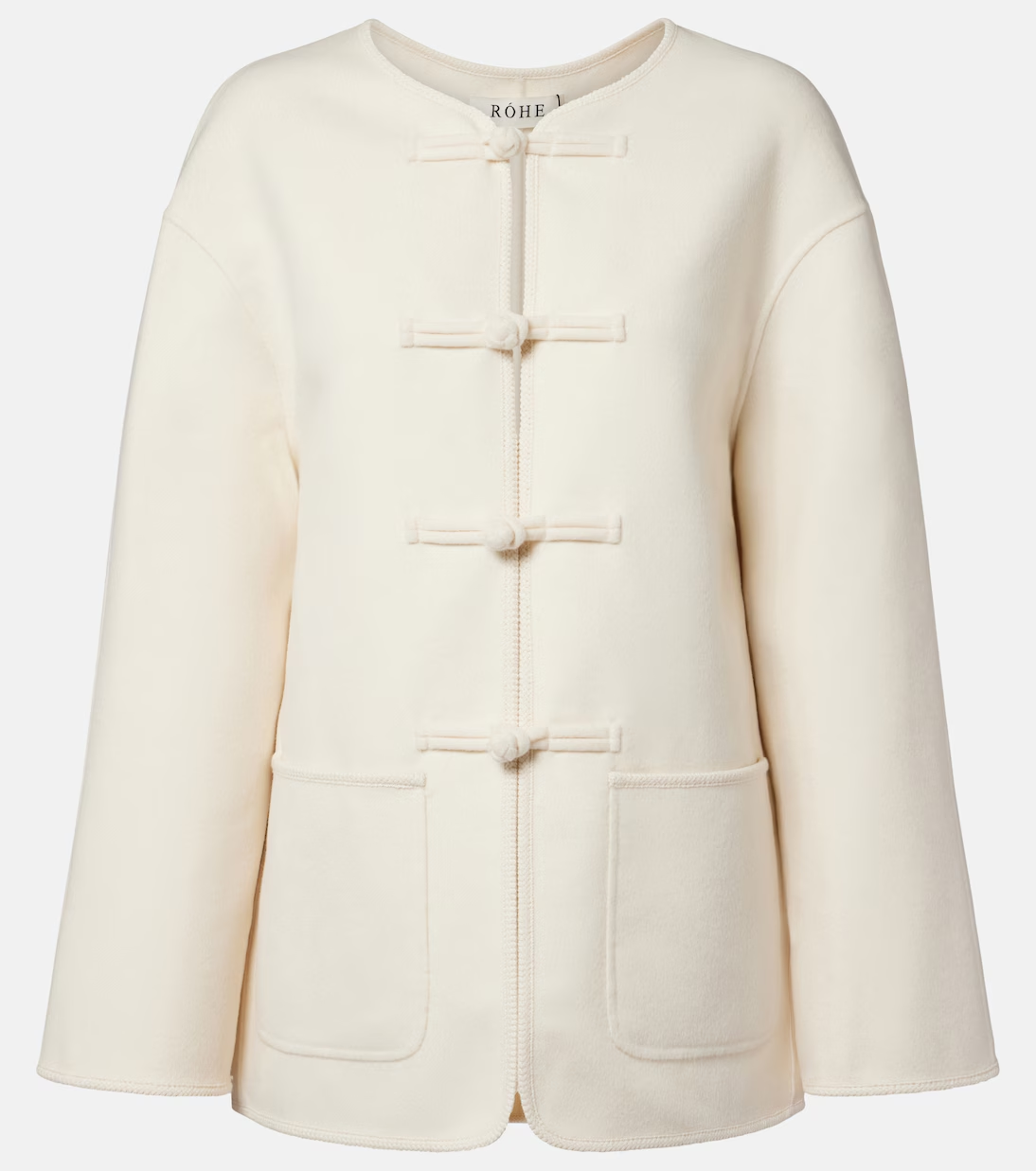
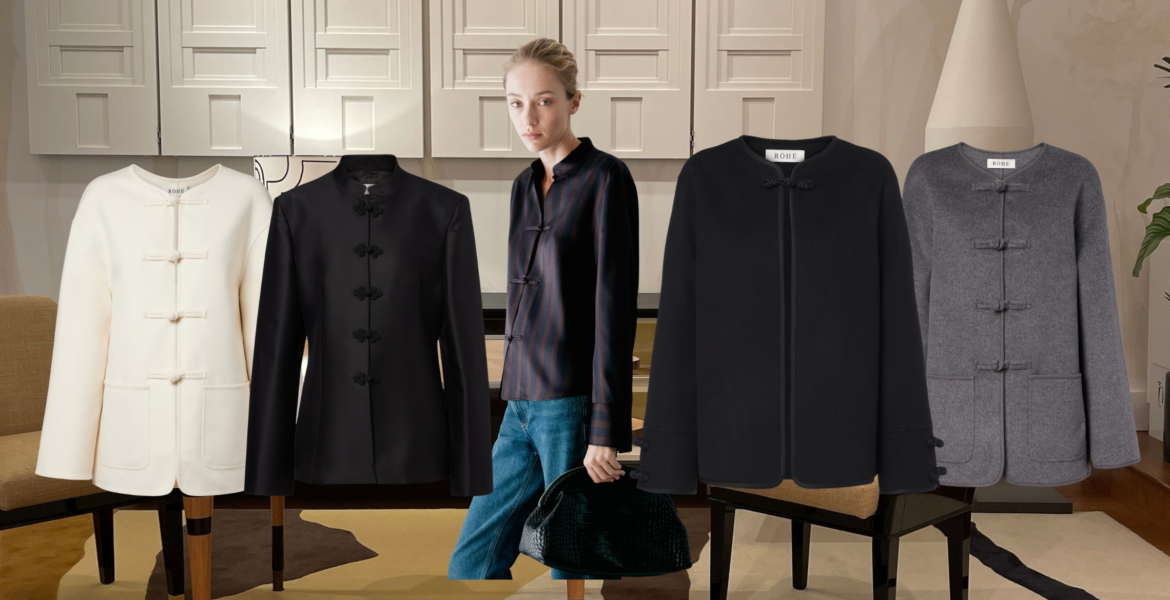
Róhe is perhaps the clearest example. The brand has a dedicated The Pankou category, with pankou closure jackets, ponchos, dresses, tops and other pieces appearing across its collections. Its Fall Winter 2026 assortment includes multiple pankou jackets in different colors and proportions, showing that the detail is not being treated as a novelty. It has become a design language.
Adidas has brought the reference into another fashion vocabulary altogether. Its 2026 collaboration with CLOT by Edison Chen includes garments and footwear using frog button closures alongside Mandarin collars and other Chinese design references. That combination is significant because it places a traditional fastening inside contemporary sportswear rather than keeping it confined to formal heritage dressing.
The result is a strange and very modern fashion equation: a centuries old construction detail suddenly looks fresh because designers are changing everything around it.
What Is a Frog Button?
A frog button is a decorative garment fastening made from cord, fabric or braided material. Instead of the conventional button and buttonhole, the closure uses a knot or toggle on one side and a loop on the other. The fastening works mechanically, but it also creates a visible ornament on the front of the garment.
In Chinese dress, this type of closure is known as pankou. The Victoria and Albert Museum describes pankou as loop and knot fastenings and identifies them as a distinctive feature of traditional Chinese fashion. A 2019 qipao in the museum’s collection, made in Shanghai using traditional construction methods, is finished with these characteristic closures. Victoria and Albert Museum
That distinction matters because fashion often takes an intricate cultural object and turns it into a vague aesthetic category. Calling pankou simply “Asian inspired” loses the very thing that makes the detail interesting. The history is specific. The technique belongs to a particular garment making tradition, and understanding that specificity makes the modern fashion revival more meaningful, not less.
The name frog button comes from Western fashion terminology, but the form can refer to different traditions. That is where the story gets even more interesting.
The Frog Button Has More Than One Fashion History
There is a useful distinction between pankou and Western frogging, even though the visual vocabulary can overlap.
In European fashion, frogging refers to ornamental braid or cording used as a garment closure or purely as decoration. The Fashion Institute of Technology’s Fashion History Timeline traces its strong association with military uniforms, especially elaborate cavalry and hussar clothing from the eighteenth and nineteenth centuries. Over time, the braid became so decorative that it could remain on garments even after it stopped serving a practical fastening function. Fashion History Timeline
This is a revealing detail in the history of fashion. Once something becomes visually recognizable, its original function can become secondary. The fastening turns into symbolism.
Military frogging communicated ceremony, rank and status. The elaborate braid was not simply there to hold fabric together. It told you something about the wearer before the wearer said anything at all. FIT notes that frogging spread across garments associated with class, status and occupation, eventually appearing in ceremonial clothing as well. Fashion History Timeline
Pankou carries a different cultural history. It is rooted in Chinese clothing traditions and became an important part of garments such as the qipao, where the closure is both functional and visually central. The V&A’s documentation shows the technique continuing into contemporary Chinese fashion through garments made with traditional methods. Victoria and Albert Museum
Put the two histories beside one another and an interesting fashion principle emerges: a closure can become a cultural signifier.
That is precisely why the current revival deserves more attention than a simple trend label.
SHOP OUR PICKS
Fashion Is Suddenly Making the Construction Visible
For years, one of the dominant luxury ideals was visual restraint. Clean lines, hidden details and minimal hardware became shorthand for sophistication. But fashion in 2026 is increasingly fascinated by the opposite idea: show me how the garment was made.
You can see the same instinct in the return of intricate closures, decorative buttons, embroidery, elaborate trims, corsetry and tactile fabrics. The appeal lies partly in their visibility. Instead of being asked to admire only the silhouette, the eye is given something to investigate.
The frog button works particularly well because it creates a rhythm down the garment. One closure leads into the next, almost like punctuation marks across a sentence. The eye follows the center line, notices the knotting, registers the contrast and then returns to the larger silhouette.
That makes the detail unusually powerful.
A plain cream jacket with four dark pankou closures can feel more distinctive than a heavily embellished jacket because the design is concentrated rather than scattered. Róhe’s current pankou pieces demonstrate exactly this approach. The silhouettes remain restrained while the closures provide the identity.
This connects directly to the Rópard idea explored in The Cut of a Coat Matters More Than the Trend. A garment is not interesting because it contains the correct trend vocabulary. It is interesting because proportion, construction and detail work together.
The frog button is proof.
Why Frog Buttons Make So Much Sense for Modest Fashion
Modest dressing has always had a complicated relationship with fashion’s obsession with visual impact. Many designers create interest through exposed skin, dramatic cutouts, transparent layers or unusual openings. A modest wardrobe needs other ways to create visual tension.
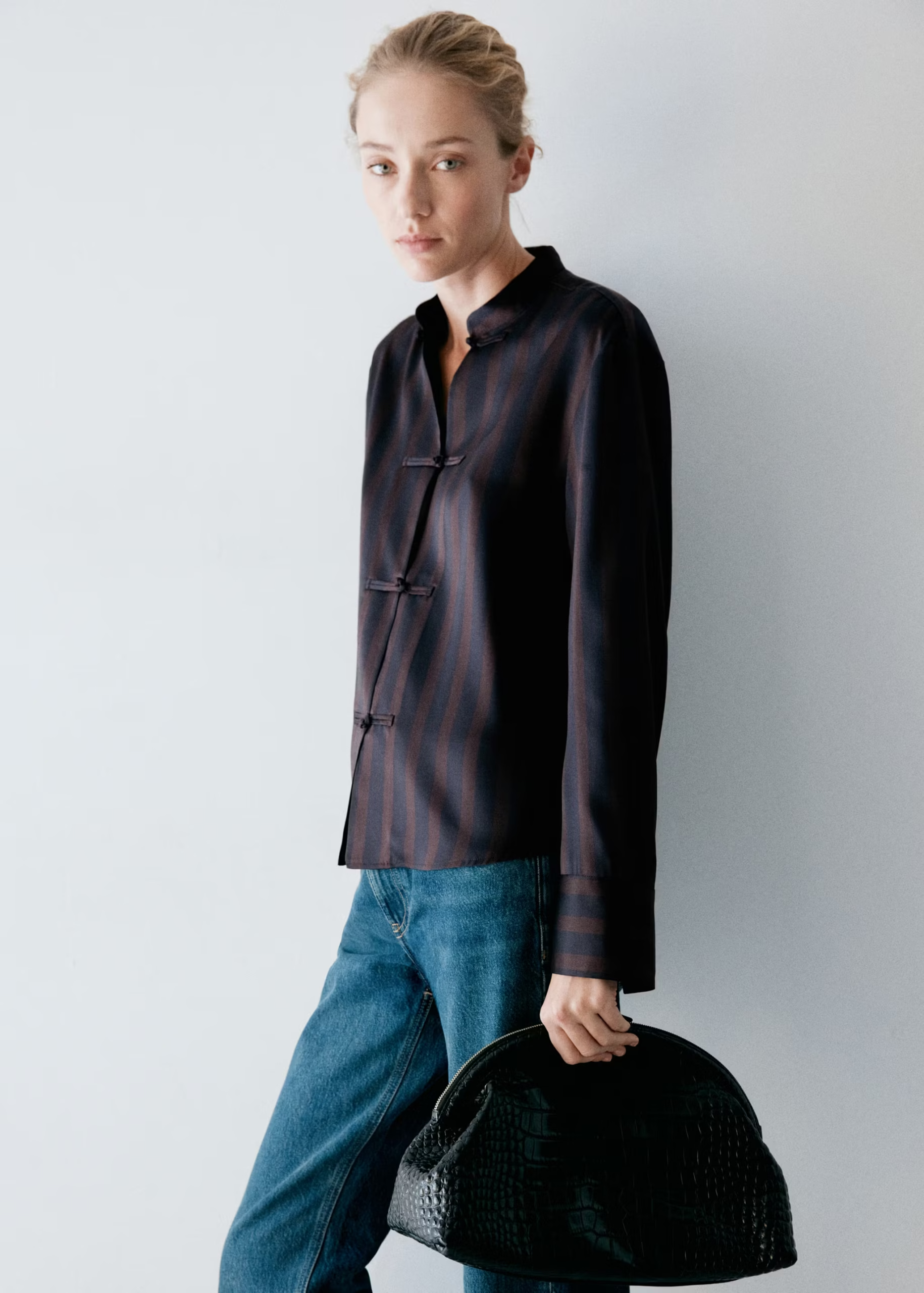
The frog button offers one. It allows a garment to be visually expressive without relying on exposure. A high collar with a row of sculptural closures can make a simple jacket feel architectural. A long coat with contrasting frog buttons can create a strong vertical line. A loose blouse with one carefully placed closure can become the focal point of the entire outfit.
This is not about making modest clothing quieter. It is about changing where the visual energy lives. Instead of asking the neckline to do all the work, the construction can do it.
That is a much more sophisticated approach to modest style because it expands the design vocabulary. The wearer does not have to choose between covering the body and having an interesting outfit. The garment itself becomes the object of attention.
For readers interested in the relationship between silhouette and styling, this also connects naturally to Why Proportion Is the Secret Behind a Great Outfit. Frog closures tend to work best when the rest of the outfit gives them enough space to be seen. A structured jacket with wide leg trousers, a long coat over a simple dress or a detailed blouse with a clean skirt allows the closure to act as the visual punctuation rather than one more competing element.
How to Wear Frog Buttons Without Making the Outfit Feel Like a Costume
The most modern way to wear frog buttons is to let them exist between references.
A traditional looking closure becomes much more contemporary when the surrounding wardrobe is unmistakably current. Think a minimalist pankou jacket with wide trousers, a tailored skirt or dark denim rather than an outfit that attempts to recreate an entire historical silhouette.
The same principle applies to color. A black jacket with black closures reads very differently from an ivory jacket with dark knots. One is subtle and architectural. The other makes the fastening the star.
Fabric matters too. Silk and brocade emphasize the heritage connection, while wool, linen, cotton and structured tailoring make the closure feel integrated into a modern wardrobe. Róhe’s current pankou pieces are a useful example because the technique appears across minimalist outerwear, dresses and tops rather than being restricted to obviously traditional garments.
The best versions do not pretend the history is irrelevant. They simply do not turn the wearer into a historical reenactment. And that distinction is important.
The Real Luxury of the Frog Button Is Knowing What You Are Looking At
There is another reason I think the frog button is worth watching. Fashion literacy increasingly comes from being able to recognize why something looks special.
Anyone can see that a jacket has an unusual fastening. A more informed eye notices that the closure changes the visual rhythm of the garment. A culturally curious eye recognizes that pankou belongs to a specific Chinese tradition. A fashion historian can distinguish that from Western frogging and understand how both traditions turned functional construction into ornament.
That progression is cultural capital. It is the difference between saying, “I like this jacket because it is trending,” and saying, “I like the way the fastening gives the garment a sense of ceremony while keeping the silhouette restrained.”
The second observation tells you much more about fashion. This is also why heritage is becoming such an important part of contemporary dressing. As explored in Why Fashion Is Looking Back at Heritage, the past is not simply being copied. Designers are selecting fragments of older systems and placing them into new contexts.
The frog button is one of those fragments.
Rópard’s Take: Stop Looking Only at the Big Trend
The most interesting thing about the frog button is not that it is back. It is why we are noticing it now.
Fashion has spent years training us to look for the obvious signal: the new silhouette, the next It bag, the trending color, the logo. But increasingly, the more sophisticated fashion conversation is happening at a smaller scale. It is in the fastening, the collar, the seam, the textile, the way a sleeve is constructed or the tiny detail that tells you where a design idea came from.
That is where fashion knowledge becomes useful.
A frog button may be tiny, but it changes how you read a garment. It can tell you about construction, cultural exchange, military dress, craftsmanship and the contemporary appetite for heritage all at once.
And for modest dressers, there is an especially compelling lesson here.
You do not need more exposure to make a garment more interesting. Sometimes you simply need better design. That is the real reason the frog button deserves a place in the Fall 2026 conversation. Fashion’s future may be getting louder, but the smartest details are often still small.
Frequently Asked Questions About Frog Buttons
1. What is a frog button?
A frog button is an ornamental garment fastening made from cord, fabric or braid. It usually consists of a decorative knot and a loop that work together to close the garment. In Chinese fashion, these closures are known as pankou.
2. Are frog buttons Chinese?
Pankou is a traditional Chinese garment fastening and a distinctive feature of Chinese clothing. However, the Western term “frog” or “frogging” is also used for ornamental corded closures associated historically with European military dress. These traditions should not be treated as identical.
3. Why are frog buttons trending in 2026?
Frog closures have appeared across contemporary fashion in jackets, dresses, tops and knitwear, while brands such as Róhe have made pankou a recurring design feature and adidas has incorporated frog buttons into contemporary CLOT collaborations.
4. Are frog buttons good for modest fashion?
Yes. Frog closures create visual interest through construction rather than exposure, which makes them especially effective on high collar jackets, long coats, dresses, blouses and other covered silhouettes.
5. How can I wear frog buttons in a modern way?
Keep the rest of the outfit relatively clean so the fastening has room to stand out. Wide leg trousers, simple skirts, dark denim and understated accessories can make a frog button jacket feel contemporary rather than costume like.
READ THE PREVIOUS POSTS

Spring Summer 2027: Why Fashion Is Embracing Bold Shapes and Expressive Style
From sculptural skirts and balloon trousers to expressive color and visible craftsmanship, explore ten Spring/Summer 2027 runway ideas and learn how to make them work for modest style.

The Scarf Belt Is Fashion’s Softest Way to Create Shape
The triangle scarf is having a major moment for Fall 2026. From oversized coats to polished tailoring, here’s why this small accessory is becoming the season’s must have finishing touch.

The Frog Button Is Fashion’s New Punctuation
The triangle scarf is having a major moment for Fall 2026. From oversized coats to polished tailoring, here’s why this small accessory is becoming the season’s must have finishing touch.