- About Modest Fashion, The Styling Atelier
- September 15, 2026
- 0
Why Fashion Is Looking Back at Heritage
If you are the kind of woman who can spot a beautiful old coat in a photograph and immediately wonder where you could find one today, fashion’s current obsession with heritage is worth watching.
Fashion is looking backward, but not because designers have suddenly run out of ideas.
The more interesting explanation is that the industry is becoming increasingly interested in things that cannot be produced overnight: history, craftsmanship, recognizable design codes, cultural memory and the feeling that a piece might still matter years from now.
That is why heritage fashion is becoming such an important part of the current fashion conversation. The archive has become a creative resource. Old silhouettes are being reinterpreted. Historical techniques are being revived. Fashion houses are returning to their own visual languages, while younger designers are looking outside the traditional fashion archive for references that feel more personal.
For modest dressers, this shift is particularly interesting. A fashion culture obsessed with novelty has often treated coverage, longer silhouettes, tailoring and layering as functional requirements rather than design opportunities. Heritage offers another way of seeing them. A long coat can carry architectural history. A high neckline can recall a particular decade. A full skirt can connect contemporary dressing to couture, cinema or social history.
The past is not simply returning. Fashion is deciding which parts of the past deserve another life.
Why is heritage making a comback?
Heritage fashion is gaining attention because designers and consumers are increasingly valuing identity, craftsmanship and continuity over disposable novelty.
That shift can be seen across fashion’s most influential houses and younger labels. Archives are being opened, historical collections are being studied and familiar silhouettes are being translated for new audiences. The Musée des Arts Décoratifs‘ 2025 exhibition marking 100 years of Art Deco is one example of the wider cultural appetite for historical design, bringing together nearly 1,000 works across fashion, jewelry, furniture, graphic arts and other disciplines.
But there is an important distinction here. Fashion is not simply becoming nostalgic. Nostalgia wants the past to feel comforting. Heritage is more demanding. It asks what is worth carrying forward.
That difference explains why some of today’s strongest historical references do not look particularly old at all.
Why is Art Deco back in fashion?
Art Deco is returning at an interesting moment. The movement reached its defining moment at the 1925 Paris Exposition, making its recent centenary an obvious reason for renewed attention. But the revival goes beyond an anniversary. Art Deco offers fashion something that has felt increasingly absent after years of minimalism and quiet luxury: glamour, decoration, structure, and visible craftsmanship.
Its appeal also comes from how modern it still looks. Art Deco was fascinated by technology, architecture, geometry, and the excitement of a changing world. Today, designers are borrowing those same principles rather than simply recreating 1920s clothing. Fall 2026 collections are bringing back geometric motifs, fringe, velvet, embellishment, and elongated evening silhouettes, while Chanel has translated Art Deco architecture into contemporary knitwear.
For the modern wardrobe, that makes Art Deco less about dressing historically and more about embracing a particular design language. Think strong symmetry, rich textures, architectural silhouettes, and jewelry that feels almost sculptural. After an era obsessed with looking effortless, Art Deco makes a compelling case for something else: the beauty of looking deliberately designed.
Is fashion tired of constant newness?
Fashion’s obsession with newness has created its own problem: when everything is constantly replaced, very little feels meaningful.
A runway collection arrives. A trend peaks. A new aesthetic replaces it. A silhouette that seemed outdated six months earlier suddenly becomes desirable again. The speed can be exciting, but it also creates a strange sense of disposability.
Heritage offers the opposite feeling. It suggests that a garment can have a life beyond the season in which it appears. The appeal of an archive piece is not only that it looks beautiful. It has survived. It has a story, a recognizable construction, a relationship to a particular designer or period.
This is one reason the return to heritage is more significant than another round of vintage inspired styling. Fashion is beginning to ask a different question: what deserves to last?
That question also explains the renewed attention to craftsmanship. A hand embroidered surface, an unusual textile, a carefully engineered sleeve or a distinctive coat construction gives the garment something that trend cycles cannot easily reproduce.
For Rópard readers, this matters because modest dressing has always had a natural relationship with these ideas. Longer proportions, layering, tailoring and covered silhouettes create opportunities for construction and material to become the focus rather than exposure.
The current fascination with heritage makes those qualities newly relevant.
What does McQueen’s Fall 2006 collection teach us about heritage fashion?
Alexander McQueen’s Fall 2006 collection, Widows of Culloden, shows how heritage can become intensely personal rather than simply decorative.
McQueen repeatedly drew from his Scottish heritage, but Widows of Culloden was particularly direct. The collection referred to the final battle of the Jacobite Risings and explored Scottish political history through exaggerated silhouettes, tartan, lace and historical references. The Metropolitan Museum describes McQueen’s Scottish heritage as central to several of his collections and identifies Widows of Culloden as one of his most significant explorations of it.
The clothes were not historical costumes. That is the important part.
McQueen used the past as emotional material. Bustled silhouettes, nipped waists, tartan and lace were transformed through his own dramatic vocabulary. One dress in the collection combined McQueen wool tartan with black lace, while another used pheasant feathers and a silhouette based on 1890s dresses.
The result was not a reconstruction of Scotland. It was McQueen’s interpretation of Scotland.
That is what makes heritage powerful in fashion. It allows a designer to say something about identity without simply reproducing an old garment.
Can fashion use history without becoming nostalgic?
Prada’s Fall 2009 collection offers a quieter answer: yes, because historical references can be stripped of their original context and given a new function.
The collection arrived during the aftermath of the global financial crisis, when designers were responding to a very different economic mood. Prada’s collection included boiled wool suits and restrained tailoring, part of a wider move toward sobriety on the Fall 2009 runways. Contemporary commentary on the season described Prada’s boiled wool suits as a response to the new atmosphere of austerity.
Prada is useful here because the collection does not need to announce its historical references loudly.
The clothes feel considered rather than theatrical.
That is often how heritage works best. Instead of copying an entire decade, designers borrow one element: the proportion of a coat, the severity of a suit, the weight of a fabric or the shape of a shoulder.
Prada’s own Real Fantasies project for Fall/Winter 2009 framed the collection through themes of untouched nature, looming crises and urban decadence, showing how the collection’s visual world extended beyond clothing into a broader cultural mood.
This is why archive fashion should not be confused with costume. A costume tells you which period it belongs to. Good fashion makes you wonder.
Why does fashion house heritage matter?
Valentino’s Fall 2018 Couture collection shows another version of heritage: the fashion house as a living archive.
Pierpaolo Piccioli did not choose one historical period and reproduce it. Instead, he brought together Greek mythology, seventeenth and eighteenth century painting, medieval armor, Renaissance references, Pasolini, Deborah Turbeville and Ziggy Stardust. The result was a collection that moved between centuries rather than belonging neatly to one.
That is a more sophisticated relationship with heritage. A fashion house does not have to preserve its past exactly as it was. It can build a vocabulary from it.
Valentino’s history is associated with couture, dramatic color, romanticism, extraordinary craftsmanship and evening dressing. Piccioli could therefore take those values and push them into something new.
The collection was extravagant, but the deeper idea was surprisingly simple: heritage can provide a designer with a foundation from which to experiment.
This is particularly visible in couture, where craftsmanship itself becomes part of the heritage. The Fall 2018 Valentino collection used elaborate embroidery, brocade, sequins, pearls, feathers, pleating and sculptural volumes.
The lesson is important for anyone interested in modest fashion. A modest wardrobe does not need to be built around trend recognition. It can be built around a recognizable design language: beautiful coats, strong tailoring, interesting sleeves, layered proportions, rich textiles and silhouettes that remain relevant after the trend disappears.
Why is Dior Spring 2025 such an important example of heritage fashion?
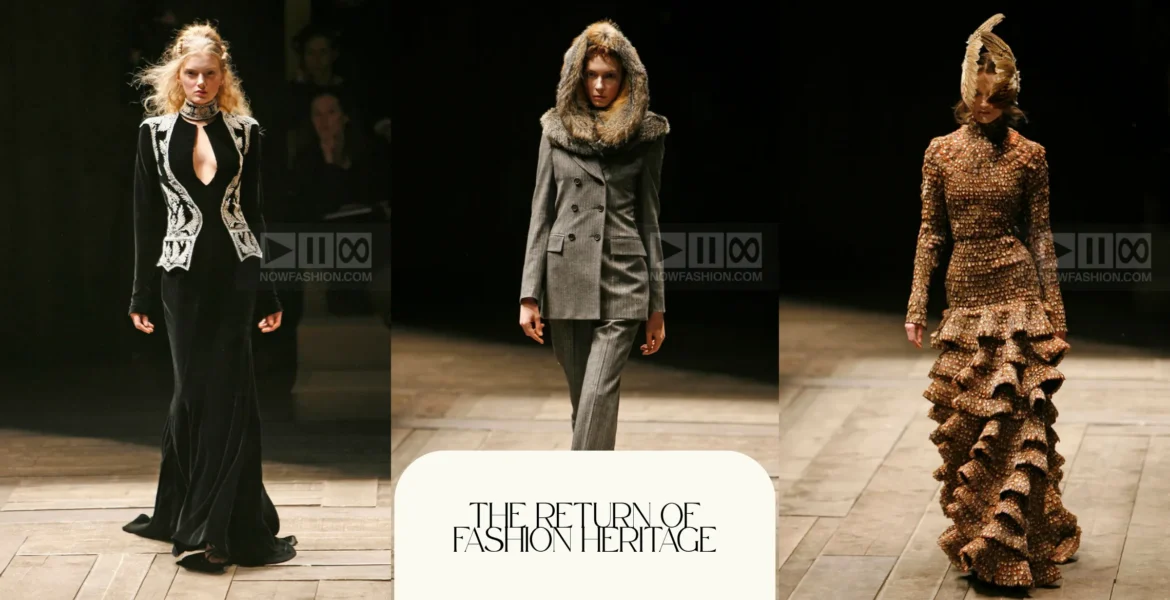
Dior’s Spring Summer 2025 Ready to Wear collection makes the archival turn particularly clear because Maria Grazia Chiuri began with the house archive, then pushed its historical codes into a more athletic and physically assertive wardrobe.
For the collection, Chiuri revisited Christian Dior’s Amazone dress from Fall Winter 1951 to 1952. Dior described the process as a return to the origins of fashion and a reconsideration of the relationship between the body and what dresses it, between intention and function.
That idea became visible from the opening look, which paired a deep-neck, high-cut black swimsuit with knee-high boots. The collection then moved between bodysuits, technical leggings, nylon jackets, and track pants, alongside off-the-shoulder blazers, trench coat dresses, and pleated evening gowns.
Sport was not treated as a decorative motif. It became the framework through which tailoring and eveningwear were reconsidered.
The collection repeatedly contrasted compression with volume. Asymmetrical bodysuits and technical jerseys traced the body closely, while wide-leg trousers, cargo pants, pleated skirts, and floor-length tulle expanded it. This movement between exposure and coverage gave the archival references a distinctly contemporary meaning.
Chiuri also disrupted the traditional double-breasted jacket. Lapels folded outward to expose the collarbone, while internal waist shaping preserved the authority of tailoring. Padded shoulders remained sharply defined even when the torso flared into peplum volumes or connected to relaxed, side-striped trousers.
Image credits: nowfashion – Christian Dior RTW Spring/Summer 2025, Paris
The material contrast reinforced the collection’s argument. Stretch nylon and neoprene created smooth, athletic surfaces, while wool gabardine, cotton poplin, tulle, jacquard, and beaded fringe restored density and texture. The reliance on synthetic performance fabrics also introduced a tension between athletic luxury and the material richness traditionally associated with couture.
Accessories continued the same language. Heavy-soled knee-high boots, lace-up footwear, crossbody straps, utility pouches, and elasticized headbands carried the vocabulary of competition into tailored and evening silhouettes.
The strongest looks were those in which the athletic and formal elements became inseparable. A white double-breasted blazer with side-striped track pants balanced formal rigor with physical ease, while an asymmetric trench coat dress grounded by tall boots transformed a familiar house code into something more mobile.
Christian Dior created the original Amazone dress in 1951. Chiuri did not simply ask how that dress could look relevant in 2025.
She asked what its idea could do in 2025.
That distinction is everything.
The historical garment became a starting point for a conversation about movement, strength, femininity, and the relationship between clothing and the body. Dior Spring 2025 shows that heritage fashion is most powerful when it does not preserve the past intact. It compresses, expands, destabilizes, and rebuilds it for the way the modern body moves.
What does heritage fashion mean for modest dressers?
Heritage fashion gives modest dressers permission to think about clothing as design rather than simply coverage.
A longer hemline is not automatically fashionable. A high neckline is not automatically elegant. A loose silhouette is not automatically sophisticated. What makes these things compelling is what the designer does with them. Consider the coat. A coat can reference military tailoring, 1930s architecture, 1950s couture, seventies minimalism or traditional menswear without looking like a costume. Its meaning comes from proportion, fabric, construction and styling.
For modest dressers, this way of looking at fashion is useful because it shifts attention away from the assumption that modest clothing is simply clothing with more fabric. More fabric creates more design possibilities. A sleeve can become architectural. A skirt can create movement. A coat can establish an entire silhouette. Layering can create proportion. Fabric can become the focal point.
The heritage conversation gives us a language for understanding those choices.
Is heritage fashion about copying the past?
The best heritage fashion does not reproduce the past. It edits it.
That is the thread connecting McQueen, Prada, Valentino and Christian Dior.
McQueen turned Scottish history into autobiography. Prada transformed restraint and historical tailoring into a response to its contemporary economic moment. Piccioli treated centuries of visual references as ingredients for modern couture. Dior returned to its own archive, taking Christian Dior’s 1951 Amazone dress and translating its ideas into a contemporary athletic wardrobe.
Four designers. Four different relationships with history.
That is why the current archive obsession deserves more attention than simply calling it a trend. A trend can be copied. Heritage has to be interpreted. And interpretation requires knowledge. You have to know what the original silhouette meant before you can change it intelligently. You have to understand a textile before you can modernize it. You have to recognize a house code before you can challenge it. This is also where fashion’s relationship with cultural heritage becomes more complicated. Archives can preserve objects, but living traditions depend on people who continue to practice techniques and transmit knowledge. The value of heritage therefore extends beyond an old photograph or an archived dress.
The real question is whether the knowledge behind the object survives.
Why does the return to heritage matter now?
Fashion is looking backward because the past offers something the speed of trend culture cannot manufacture: context.
The renewed interest in archives, craftsmanship, historical silhouettes and Art Deco is not simply evidence that fashion is nostalgic. It reveals a desire for clothes that feelconnected to something larger than the season. That could be a fashion house‘s history. It could be a designer’s family. It could be a national identity. It could be an architectural movement. It could even be a technique that took generations to develop.
The most interesting fashion of the next few years may therefore come from designers who know how to look backward without becoming trapped there. For the wearer, that creates a different kind of fashion literacy.
Instead of asking only, “Is this trending?” ask: Where did this shape come from? Why does it look the way it does? What history is being referenced? What has the designer changed? And what makes this worth keeping?
Those questions turn shopping into observation. They also make getting dressed more interesting.
Because perhaps the real appeal of heritage fashion is not that it allows us to dress like another time. It allows us to understand our own time more clearly.
Frequently Asked Questions About Fall Winter Coats
1. What is heritage fashion?
Heritage fashion refers to clothing and design that draws on historical identity, archives, craftsmanship, cultural traditions or established fashion house codes. It can involve reinterpreting old silhouettes, reviving techniques or translating historical references into contemporary clothing.
2. Why are fashion designers looking at archives again?
Archives give designers a source of recognizable ideas at a moment when fashion is saturated with constant newness. They provide silhouettes, materials, techniques and visual codes that can be reinterpreted rather than invented from scratch.
3. Is heritage fashion the same as vintage fashion?
No. Vintage fashion refers primarily to older garments that are worn or collected. Heritage fashion is broader. A contemporary garment can be heritage inspired even when it was designed and produced this season.
4. Why is Art Deco influencing fashion in 2026?
The 2025 centenary of the 1925 Paris exhibition renewed cultural attention around Art Deco, while its geometric forms, ornament and relationship between modernity and craftsmanship remain highly adaptable. Fall 2026 collections continue to translate these qualities into contemporary clothing.
5. What can modest dressers learn from heritage fashion?
Heritage fashion encourages a closer look at proportion, construction, textiles and silhouette. For modest dressers, that can mean treating coverage as a design opportunity rather than simply a practical requirement. Long coats, layered proportions, generous skirts and architectural tailoring can all become part of a distinctive fashion language.
READ THE PREVIOUS POSTS
A New Chapter for the Leather Jacket
Leather jackets are entering a new chapter for 2026, moving beyond the classic biker into oversized bombers, refined tailoring and longer silhouettes. Discover what is driving the trend, how to choose quality leather, and how to style it modestly.
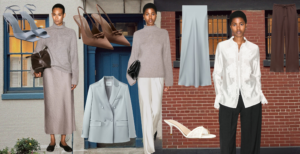
Lace and Satin Fashion Trends: Why Romance Is Back in 2026
Lace and satin are back for 2026, but the real trend is bigger than the fabrics themselves. Fashion is embracing romance, texture, movement and visible craftsmanship again. For modest fashion, that means these traditionally sensual fabrics can be reinterpreted through layering, proportion and thoughtful construction.
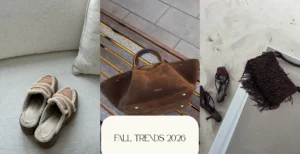
15 Bold Fall 2026 Trends Every Fashionista Should Watch
Fall 2026 is bringing fashion back to texture, volume, color and personality. From suede and velvet to fringe, barrel jeans, oversized blazers, bold colors and the return of the pencil skirt, discover the 15 trends shaping the new season.